Helsinki 2026: why Finland's capital is next year's destination
A capital that has chosen human scale
Helsinki is not a metropolis that crushes you. It is a city built on a human scale, where moving on foot between the port, the center and the creative neighborhoods takes only a few minutes but offers completely different views. This compactness is not a limitation: it is a philosophical choice that reflects the Finnish character, sober and functional, allergic to excess. The architectures of Carl Ludwig Engel in the neoclassical heart of the city dialogue without conflict with the red brick buildings of converted warehouses and contemporary constructions overlooking the Baltic. It is a city that knows how to hold together different eras without shouting.
Design as a way of thinking about the world
Finland has a relationship with design that goes well beyond aesthetics. Here design has historically been understood as a democratic tool: beautiful, durable and accessible objects for all. This tradition, which traces its roots to the postwar period and the need to rebuild a country with few resources, has produced a sensibility that can still be felt walking through the city. It is not about polished museums with pompous captions, but a material culture that lives in cafés, in public buildings, in markets. The neighborhood that once housed factories and industrial warehouses has become the creative heart of the city without losing its raw and authentic character.
The sea, the islands, the visceral relationship with nature
Helsinki is a peninsula embraced by an archipelago of thousands of islands. This is not a geographical detail: it is the key to understanding the psychology of its inhabitants. In summer, Finns escape to the islands with an almost ritual regularity. Some of these islands are reachable in just a few minutes by ferry from the city center and offer landscapes of smooth rock, twisted pines and open sea that seem far removed from any urban context. Even in winter, when the waters partially freeze and light is a precious and rare thing, the relationship with water does not break: it transforms.
The sauna: a social institution, not a luxury
No article about Helsinki would be honest without talking about the sauna. But it is necessary to immediately rid ourselves of a misunderstanding: in Finland the sauna is not a wellness treatment from a boutique hotel. It is a communal space, almost sacred in its simplicity, where important things and mundane things are discussed, where social hierarchies relax and silence is respected as much as conversation. Public saunas overlooking the sea represent one of the most authentic rituals a traveler can experience in Europe. Entering ice-cold water after the warmth of steam is not masochism: it is, say the Finns, the fastest way to feel alive.
Eating in Helsinki: between forest and Baltic
Finnish cuisine has undergone a profound transformation in recent years, driven in part by the Nordic wave that started in Copenhagen and then developed with its own identity. Raw materials are the starting point: Baltic fish, mushrooms foraged in the woods, wild berries, reindeer meat. But the most interesting thing is not the exotic ingredient: it is the way Finnish chefs have learned to look at their own territory with fresh eyes, rediscovering preservation and fermentation techniques that had almost disappeared. The result is a rooted cuisine that tells the story of a specific and unrepeatable landscape.
The light: the true spectacle of Helsinki
Those who choose to visit Helsinki in winter know that light is scarce and precious. The hours of sunshine can be counted on the fingers of one hand, the sky takes on shades of gray and pink that are not seen elsewhere, and the city illuminates itself with candles, lamps and reflections on frozen water. There is a visual quality to the Finnish winter that photographers pursue from all over the world, but that should also be experienced simply by taking a walk. Those who arrive in summer discover the opposite: white nights in which the sun barely sets, a golden and oblique light that transforms any corner of the city into something slightly unreal. Helsinki does not have a wrong time to be visited: it has radically different seasons, each with its own personality. And it is this variability, in the end, that makes it so difficult to forget.
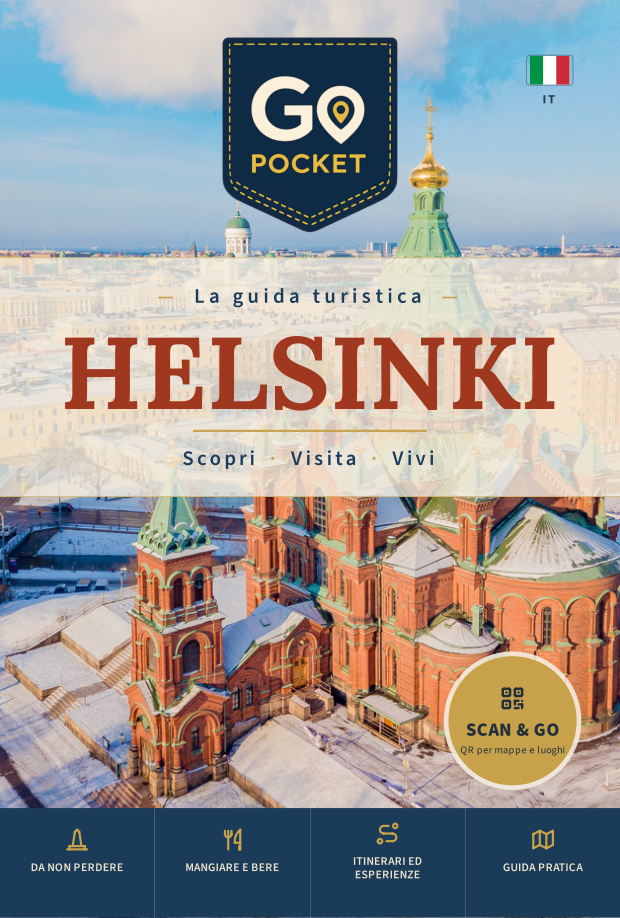
The guide to this city: Helsinki
Digital guide to Helsinki: what to see, where to eat, live maps and tips. Read it like an app, even offline.
Explore · € 4,99 →