Helsinki at the table: the rituals of food in a city that eats with its soul
The silence of the market: when buying is already a cultural gesture
The open-air markets of Helsinki have an atmosphere that is not easily found elsewhere in Europe. There is no Mediterranean chaos of overlapping voices, haggling, the insistence of vendors. Instead there is a kind of shared solemnity, almost ritual. The stalls are arranged in geometric order, products are displayed with almost aesthetic care, and customers choose in silence, with attention. Buying at the market for a Finn is a serious act, not a stroll. It is the moment when one stocks up on what the season allows, with an awareness of the natural cycle that in large European cities has almost been lost.
The herring: the fish that made history
If there is an ingredient that runs through centuries of Finnish history, it is the Baltic herring. Small, fatty, tenacious, this species of fish fed generations of coastal populations and built trade routes that in the Middle Ages connected Helsinki to the great markets of northern Europe. Even today there is an autumn festival tradition entirely dedicated to it, where fishermen from the archipelago bring their boats loaded with preserves, marinades and preparations passed down from generation to generation to the city. It is one of the few moments when Helsinki comes alive with an almost noisy liveliness, as if the smell of smoked fish had the power to loosen the typical Nordic reserve.
Rye bread: an identity that you eat
In Finland rye bread — the ruisleipä — is not a side dish. It is an identity. Its dark and dense crust, the slightly tart flavor that comes from slow fermentation, the heavy consistency that truly satisfies: all of this tells something essential about the Finnish character. In the bars and cafés of Helsinki you find it almost always, cut into thick slices, spread with butter with unexpected generosity in a culture so sober. The Finnish eat it for breakfast, lunch and as a snack, with a loyalty that does not resemble habit but conviction.
The ritual of the sauna and the food that accompanies it
You cannot talk about food in Helsinki without mentioning the sauna. Because in Finland the steam bath is never separated from eating and drinking: it is part of a complete social ritual that includes sausages grilled on hot stone, cold beer, and sometimes the great outdoor summer barbecues that last until late in the white night of July. The Finnish sausage — the makkara — cooked directly on the sauna stove is perhaps the humblest and most beloved food of the entire local cuisine. No starred restaurant will ever be able to compete with that simplicity.
The short summer and the fury of berries
Finnish summer is short, and the Finnish know it well. Perhaps for this reason, when it arrives, they live it with an almost feverish intensity. The forests fill with berry pickers — wild blueberries, wild strawberries, raspberries, currants — and the city itself seems to transform: parks fill with impromptu barbecues, cafés open their outdoor seating, and in home kitchens people work tirelessly to prepare jams, juices and preserves that must last until the following winter. It is an ancient gesture, almost ancestral, that modernity has not erased: to gather, to preserve, to prepare.
The new Nordic cuisine: Helsinki between tradition and invention
In the last two decades, Helsinki has undergone a true gastronomic revolution. On the wave of the movement born in the Scandinavian countries, a new generation of chefs has rediscovered local ingredients — mushrooms, fish from the archipelago, wild herbs, algae from the Baltic — and reinterpreted them with contemporary techniques and a very refined aesthetic sensibility. The result is not imitation of tradition, but deep dialogue with it. One eats dishes that seem simple and hide complexity built with months of fermentation, slow cooking, botanical study. It is a cuisine that tells the Finnish landscape with the same precision as a photograph.
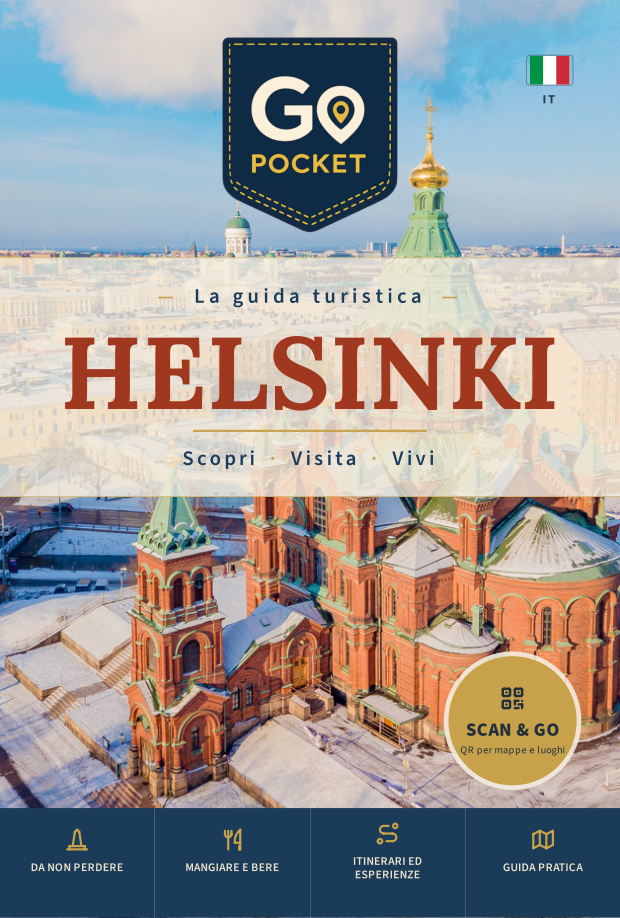
The guide to this city: Helsinki
Digital guide to Helsinki: what to see, where to eat, live maps and tips. Read it like an app, even offline.
Explore · € 4,99 →