Helsinki off the beaten path: the unusual experiences you don't expect
The public sauna, a social ritual (not a luxury)
In Finland the sauna is not an optional spa hotel amenity: it is a deep cultural practice, almost sacred, that for centuries has accompanied births, deaths, family gatherings and business negotiations. In Helsinki there are historic public saunas where locals gather not to relax in the modern sense of the term, but to socialize in a radically honest way. No hierarchies, no clothes, no filters. It is one of the few contexts in which the celebrated Finnish reserve literally dissolves. Entering one of these facilities — many overlooking the Baltic directly — means participating in something that Helsinkians consider as normal as it is essential. The plunge into ice-cold water after intense heat is not a stunt for tourists: it is the heart of the ritual, the moment when body and mind reset.
Navigating the archipelago in winter, when the sea freezes
The Helsinki archipelago is composed of hundreds of islands, and most visitors know it in its summer version: ferries, picnics on the grass, cycling through the woods. But there is a time of year when this landscape becomes something completely different and almost lunar: when the bay freezes enough to allow long walks on solid sea. Some local specialized guides organize excursions on foot or with snowshoes through frozen channels that in summer are traveled by boat. Walking on the Baltic while the winter light transforms everything into a palette of whites and grays is an experience that redefines the concept of silence.
Rock in the church: when the sacred meets the profane
Helsinki is home to one of the most peculiar churches in the world: carved directly into living rock, with a copper vault and unfinished granite walls, it seems straight out of a science fiction novel. But the most surprising thing is not the architecture itself — already extraordinary — but the use made of it. This church regularly hosts classical and chamber music concerts, and the natural acoustics created by the rock are simply exceptional. Sitting on a wooden bench while music bounces off the rough stone walls is a sensory experience that has no equivalent in normal concert spaces.
Picking mushrooms in urban forests
One of the Finnish peculiarities most difficult to understand for those from cities where greenery is ornamental is the so-called Everyman's right — in Finnish jokamiehenoikeus — which guarantees anyone the freedom to walk, camp and pick wild berries or mushrooms practically anywhere, even on private land, as long as no damage is caused. In Helsinki this translates into something extraordinary: living in a Nordic capital and having forests within a metro ride where you can pick wild mushrooms is a daily reality for many residents.
The covered harbor market, between history and gastronomy
Helsinki has an intense relationship with seafood, and the most honest way to understand it is to frequent the historic covered market overlooking the harbor — one of the oldest in the city, active for over a century. It is not a market reworked for tourists with vintage packaging and inflated prices: it is a place of real shopping, where fishermen bring the day's catch and shopkeepers know each other by name across generations. The atmosphere is dense, somewhat melancholic out of season, vibrant in summer when boats dock right in front.
The floating sauna, where the Baltic is always close
If the public sauna represents tradition, Helsinki has managed to reinvent this ritual in a contemporary way as well. In recent years, floating structures have emerged — actual rafts with a small sauna on board — where you heat up and then throw yourself directly into the sea, whatever the season. It is not a bizarre idea but a logical evolution of a practice that has always had the sea as its natural partner. In winter, this means immersing yourself in waters that hover around freezing: an experience that many Finns describe as the most invigorating sensation there is.
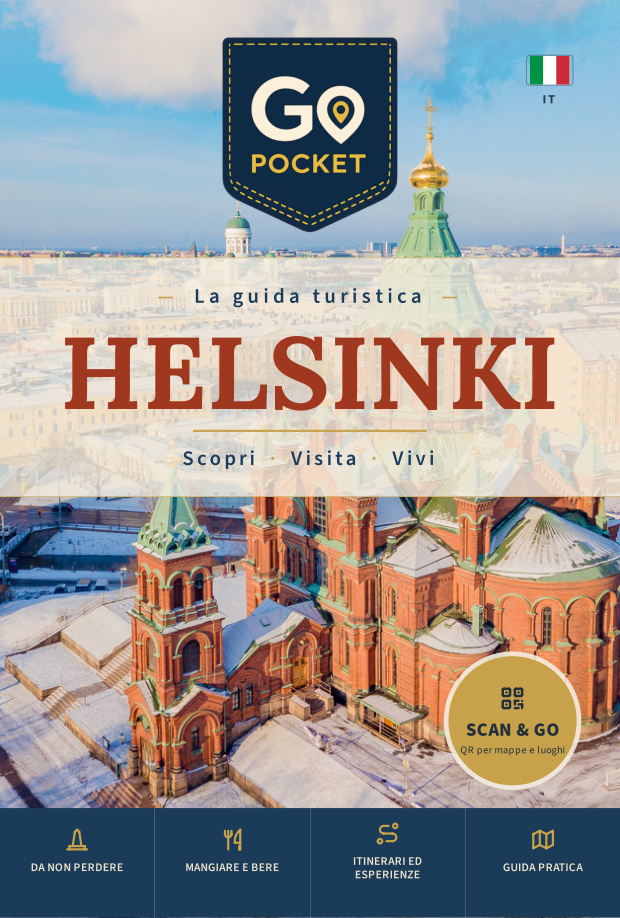
The guide to this city: Helsinki
Digital guide to Helsinki: what to see, where to eat, live maps and tips. Read it like an app, even offline.
Explore · € 4,99 →