Helsinki out of step: the capital you don't expect
A capital at the margins of the known world
Helsinki became the capital of an independent state only in the twentieth century, after centuries in which Finland remained crushed between two great neighbors, Sweden and Russia. This history of periphery — geographic, political, cultural — can still be felt in the streets, in a certain stubborn sobriety that has nothing to do with coldness. Finns have a concept, *sisu*, that doesn't translate easily: it's something between resilience, silent stubbornness and the ability to endure the unbearable without complaining too much. Walking through Helsinki knowing this changes your perspective on everything, from architecture to the people you meet at the harbor market.
Granite as identity
Almost all great European cities are built on sediments, on layers of history accumulated like pages of a book. Helsinki is built on living rock. Granite surfaces everywhere: under parks, in the foundations of buildings, along the shores. The architects of the neoclassical period and then of Finnish romantic nationalism — Eliel Saarinen above all — engaged in dialogue with this hardness rather than hiding it. An unique aesthetic emerged, which mixes the solidity of the Nordic landscape with unexpected surges of elegance. The Lutheran cathedral and the Orthodox Uspenski Cathedral, both visible from the harbor, tell in stone the two historical masters of the country: this is a city that carries its own history without needing to explain it.
The sauna is not a tourist attraction
It must be said clearly: the sauna in Finland is not a spa luxury, it's not optional, it's not an exotic experience for curious foreigners. It is a domestic, social, almost spiritual rite. For centuries public saunas have been the places where children were born, where the sick were cured, where the dead were prepared. Today that collective dimension has come back into vogue, with public saunas overlooking the sea where you immerse yourself in the waters of the Baltic between one steam cycle and the next. Whoever visits Helsinki without approaching this practice misses something essential: not the heat, but the key to understanding a different way of being together, made of shared silence and confidence gained without words.
Design as philosophy, not marketing
Finnish design has become famous in the world, but often abroad it is appreciated as pure aesthetics, as beautiful form. In Helsinki you understand that it is born from something else: from an almost obsessive relationship with function, with materials, with respect for whoever will use that object. Iittala, Marimekko, Artek: these names are not brands in the commercial sense, they are responses to a climate, to particular light, to a way of inhabiting spaces. The museums dedicated to design and architecture in the city don't just display objects: they tell a vision of the world in which the beautiful and the useful have never been in contradiction.
The archipelago begins in the city
One of the most surprising things about Helsinki is that the sea is not a backdrop: it is an integral part of the city. From the harbor you can reach in a few minutes by ferry islands that seem to belong to another world, yet are within the municipal boundaries. Suomenlinna, the fortress-island built in the eighteenth century when the city was still Swedish, is a UNESCO World Heritage site and also a living neighborhood, with permanent residents, gardens, silent courtyards. But the Finnish archipelago then extends for thousands of islands to the east and west, and Helsinki is the natural starting point for those who want to venture into that labyrinth of water and forest that is one of the great experiences of northern Europe.
The light that changes everything
Visiting Helsinki in winter and summer are experiences so different that they seem almost different cities. In summer the sun barely sets, the light becomes oblique and golden for hours, the parks fill with people who seem to want to store every photon as a reserve for the dark months. In winter darkness is the protagonist, but it's not a hostile darkness: it's the darkness of candles in cafés, of Christmas markets that smell of spiced glögi, of lights in the windows of wooden houses in historic neighborhoods. Finns have learned for centuries how to inhabit both extremes of light, and this wisdom can be felt in the atmosphere of the city in whatever season you visit it.
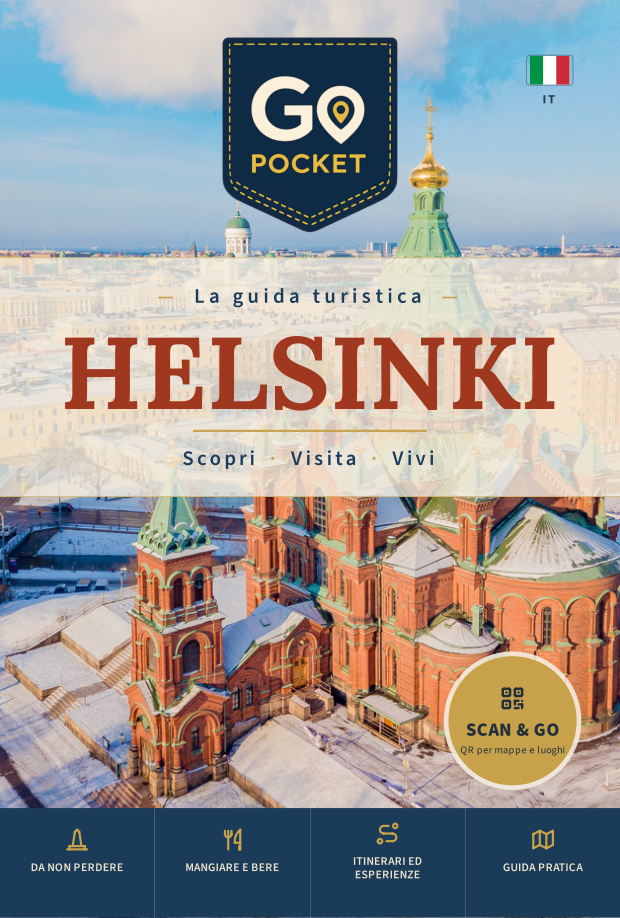
The guide to this city: Helsinki
Digital guide to Helsinki: what to see, where to eat, live maps and tips. Read it like an app, even offline.
Explore · € 4,99 →