Helsinki, the city you don't expect: unusual facts and secrets of the Finnish capital
A capital born almost by chance
Helsinki was not always the capital of Finland. For centuries the role of main center belonged to Turku, an older and more established city. It was only when Finland came under the control of the Russian Empire, in the early nineteenth century, that Tsar Alexander I decided to move the capital closer to Saint Petersburg, for both strategic and symbolic reasons. Helsinki was then a small town of a few thousand inhabitants, almost a village. Within a few decades it was transformed into a capital worthy of the name, designed in neoclassical style by German architects called specifically to give the city an imperial image. The result is that Senate Square that appears in brochures today: grandiose and somewhat theatrical, built almost from nothing to impress.
The city with more saunas than cars (almost)
Finland has a relationship with the sauna that goes well beyond simple relaxation: it is a profound cultural matter, almost spiritual. Helsinki is no exception. It is said that throughout the country the number of saunas exceeds that of automobiles, and the capital guards this tradition with pride. What surprises visitors is not so much the existence of public saunas — a phenomenon widespread throughout the country — but the context in which they are found: saunas overlooking the sea, saunas in parks, even saunas designed by world-famous architects transformed into cultural attractions. For Finns the sauna is not a luxury but a daily necessity, a place where important decisions are made, friendships are formed and events are celebrated. It is no surprise that in the recent history of the country there have been diplomatic meetings held right in a sauna.
Christmas comes from the port
There is a Christmas tradition that is entirely Helsinki-centric that few tourists know about: every year, the Peace of Christmas is officially proclaimed by the city of Turku, but Helsinki has its own secular and maritime ritual. The city's port, with its winter markets, has been a symbolic gathering point during the holidays for centuries. But the real curiosity concerns the ice: when the Baltic Sea freezes — which still happens, albeit with varying frequency — the most daring inhabitants cross on foot the stretch to nearby islands, an ancient practice that survives in collective memory and which every winter is monitored with almost ritual attention. The frozen sea completely transforms the emotional geography of the city: the archipelago islands, reached by ferry in summer, suddenly become part of the continent.
An underground network worthy of an underground city
Helsinki has a secret that flows literally beneath the feet of its inhabitants: a network of tunnels and underground spaces among the most extensive in Europe in relation to the size of the city. Built over the decades for practical reasons related to the harsh climate, this underground city hosts swimming pools, sports centers, parking lots and even churches carved into living rock. The most famous of these latter is a place of worship that seems straight out of a science fiction novel: walls of rough granite, light filtering from a circular ceiling of copper and glass, extraordinary acoustics that make it a natural concert hall as well as a religious space. The Finns have learned to coexist with rock rather than fight it, and the result is a double city, one above and one below, that doubles its possibilities without expanding outward.
The country that invented Nokia and then let it go
There is an anecdote that Helsinkians tell with a certain bitter irony: Nokia, the brand that made Finland famous around the world in the field of mobile technology, had roots far removed from the smartphone. The company was born as a paper industry in the nineteenth century, then dealt in rubber boots and telegraph cables before becoming the telecommunications giant everyone knows. This ability to reinvent itself is profoundly Finnish, and Helsinki bears its marks: the city experienced the vertiginous rise and rapid decline of Nokia like a collective novel, with all its economic and identity implications. Today it has managed to transform that crisis into an ecosystem of startups and technological innovation that makes it one of Europe's most dynamic capitals in the digital sector.
Light as collective obsession
Perhaps no other element defines Helsinki as much as light — or its absence. In summer the sun barely sets, and the city lives in a luminous delirium that alters the biological rhythms even of the most prepared visitors. In winter the opposite happens: weeks in which natural light is a precious commodity, rationed, welcomed with genuine gratitude. This extreme cycle has shaped in a profound way the architecture, interior design and even the temperament of the inhabitants. The windows are large, the colors of the interiors are light, and public spaces are designed to capture every available ray. But the most surprising thing is that this absent winter light does not generate passive melancholy: Helsinkians have transformed it into aesthetics, inventing light festivals, luminous installations and an entire visual vocabulary dedicated to darkness as creative material. The Finnish night, in short, is never truly dark.
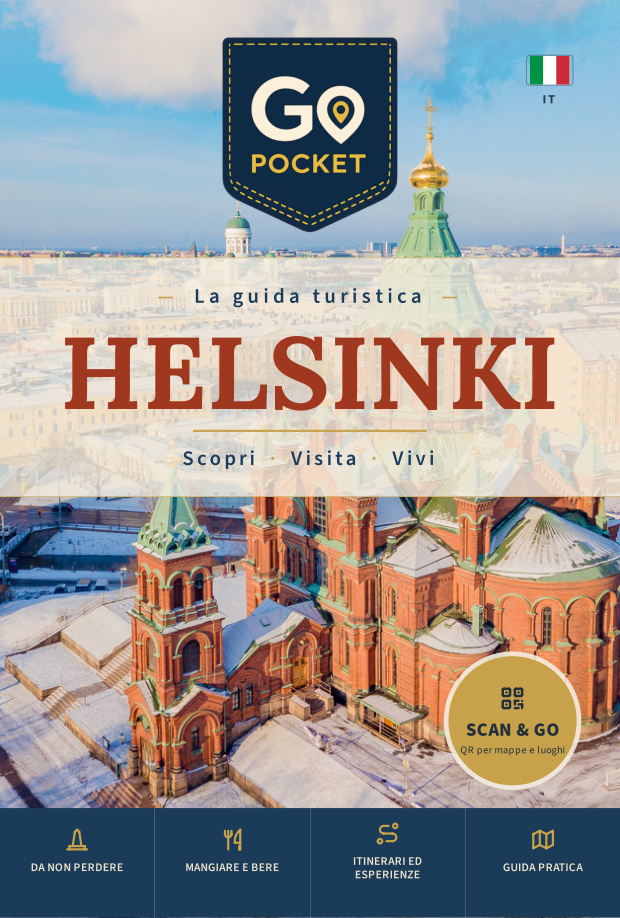
The guide to this city: Helsinki
Digital guide to Helsinki: what to see, where to eat, live maps and tips. Read it like an app, even offline.
Explore · € 4,99 →