Helsinki, the city that invented itself: the story of a capital born by decree
A city born by order of the tsar
In the early nineteenth century, when Finland came under the rule of the Russian Empire after centuries of Swedish rule, Tsar Alexander I decided that the Grand Duchy of Finland needed a capital worthy of the name. The choice fell on Helsinki, then a small fishing port with only a few thousand inhabitants, almost insignificant compared to the far more lively Turku, which until then had served as the cultural and administrative center of the country. It was a choice both strategic and symbolic: a new city, far from Sweden and closer to Saint Petersburg, where to build from scratch the image of an enlightened imperial power. The architect Carl Ludwig Engel was commissioned to redesign the heart of the city according to the neoclassical canons of the era, and thus was born Senate Square, which still surprises visitors today with its imposing and solemn geometry.
Neoclassicism as the language of power
When one walks today in the center of Helsinki and observes the white and symmetrical facades of nineteenth-century buildings, one is actually looking into a political project. Neoclassical architecture was not chosen for aesthetic reasons alone: it was the vocabulary with which the Europe of great powers communicated authority, order, civilization. The tsar wanted Helsinki to speak that language, and Engel translated it into stone and stucco with extraordinary consistency. But there is a curious and revealing detail: that formal rigor imported from outside was soon accompanied by something far more local. The Finns did not merely inhabit the imperial buildings—they filled them with lives of their own, with cultural institutions and civic associations that would sow the seeds of national independence.
The national awakening and the search for the Finnish soul
In the nineteenth century, while the rest of Europe was swept by nationalist winds, Finland too was seized by an urgency to define who the Finns were, what their language, their culture, their roots were. The most extraordinary result of this ferment was the publication of the Kalevala, the national epic collected by Elias Lönnrot as he traveled through the countryside and forests to transcribe the songs and legends of oral tradition. The Kalevala was not merely a book: it was proof that an ancient and rich Finnish culture existed, distinct from the Swedish and Russian ones. Helsinki became the center of this intellectual awakening, the city where people debated, published, argued passionately about what it meant to be Finnish. In that climate were laid the foundations of the country's modern identity.
Independence, civil war and scars still fresh
1917 brought independence, conquered in the long wave of the Russian revolution. But the newly gained freedom was immediately marked by a fierce and painful civil war, which divided the country between the red guards and the white guards in a struggle that left deep wounds for decades. Helsinki was the scene of some of the fiercest clashes, and that history was neither processed nor told openly for many years: it was too recent, too lacerting. Even today, certain moments of that period are the subject of reflection and a slow collective process of remembrance. The Finns have a word, sisu, which indicates a form of stoic tenacity in the face of adversity. Perhaps it is precisely in the trials of the twentieth century that that concept found its most concrete definition.
The Winter War and the myth of resistance
Between 1939 and 1940, little Finland found itself resisting a Soviet invasion in what became known in history as the Winter War. The proportions were absurd: a country with a reduced population against one of the great military powers of the world. Yet Finnish resistance lasted for months, surprising the entire world and becoming almost immediately legend. Helsinki was bombed in the very first hours of the conflict, and that sudden violence on the newly built and proudly modern city remained imprinted on the collective memory as a founding trauma. Peace came with the cession of significant territories, but also with a sort of silent pride: the Finns had endured. That season profoundly shaped the national character, the sense of self-sufficiency and the distrust of grand proclamations.
A city that never stops building itself
Observing Helsinki today means looking at a city that has metabolized all of this—the birth by imperial decree, the national awakening, the wars, the reconstruction—and made something original from it. The sobriety of its inhabitants, the care for public spaces, the special relationship with nature even within urban boundaries: everything bears the marks of a history in which there was no room for excess. There is in Helsinki a rare quality, which one perceives walking through its neighborhoods: the feeling that everything has a weight, a reason for being there. It is not the grandiosity of a capital built to astonish, but the seriousness of a city that knows exactly where it comes from and has chosen, with full awareness, where it wants to go.
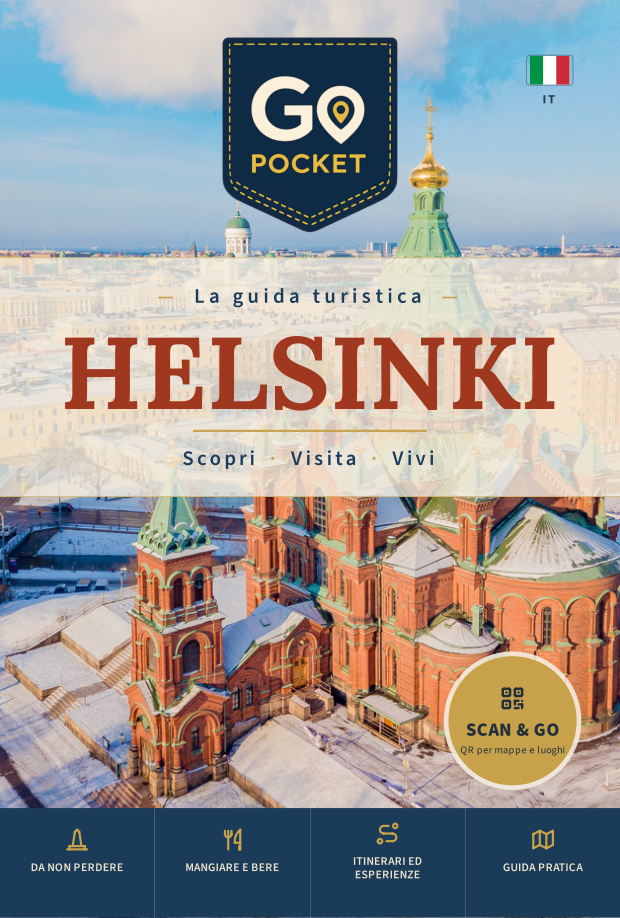
The guide to this city: Helsinki
Digital guide to Helsinki: what to see, where to eat, live maps and tips. Read it like an app, even offline.
Explore · € 4,99 →