Helsinki without getting lost: the (surprising) logic of a Nordic city
A capital on human scale
Helsinki is one of Europe's most compact capitals in terms of historic center extension. Not in the sense that it's small — the metropolitan area is quite another matter — but in the sense that the nucleus where tourist and cultural life is concentrated can be easily crossed on foot in a morning. This has an important practical consequence: before relying on any means of transport, it's worth stopping for a moment to look at the map and realizing that many of the places you want to see are perhaps only twenty minutes' walk from each other. Finns walk a lot, even in winter, and it's not by chance.
The tram: not a means of transport, a philosophy
If there is a symbol of how Helsinki moves, it is the tram. The tram network has existed for over a century and Finns treat it with the same naturalness with which buses are used elsewhere. What is remarkable is that trams cross the heart of the city with an almost meditative calm: they stop at intersections, wait for pedestrians, don't honk. Getting on a tram in Helsinki means automatically slowing your pace, and often you find yourself making a loop of the center almost by accident, looking out the window and understanding the city by osmosis.
The question of the islands
Helsinki has a complicated and beautiful relationship with water. The city is surrounded by an archipelago of over three hundred islands, some inhabited, some historically military, some simply wild. For a visitor, this creates an unexpected dimension: the city ends where the mainland ends, but continues on islands reachable in a few minutes by ferry. Some of these islands are an integral part of urban life — you go there to picnic, to swim, to spend a summer evening — and ignoring them means missing an authentic part of what Helsinki is.
Neighborhoods as states of mind
Helsinki is not homogeneous, and this is one of its merits. The historic center with the grand buildings in Russian neoclassical style — a legacy of the period when the city was the capital of the Grand Duchy under the Tsar — is just one of the city's faces. A short distance away are neighborhoods built in the early twentieth century in Art Nouveau style, the Finnish liberty, with decorated facades and silent inner courtyards. Then there are residential areas in wood that look like villages that survived urbanization, and newer neighborhoods where contemporary architecture dialogues with water in often surprising ways.
Moving around in winter (which is most of the year)
Helsinki in winter is not a degraded version of Helsinki in summer: it's simply another city. Temperatures drop, daylight hours decrease drastically and snow completely changes the geometry of urban space. This requires some practical adjustments: shoes matter more than anything else, because sidewalks can be slippery even when they look clean. Finns have a stoic and almost proud approach to winter weather — the idea that bad weather is a problem is fundamentally alien to their mentality.
Language, orientation, and the art of asking
Finnish is a language considered among the most difficult in the world for a speaker of Indo-European languages, and the names of streets and neighborhoods can look like sequences of letters impossible to memorize. The good news is that Helsinki is a city where Swedish is spoken fluently — an official language alongside Finnish — and where English is understood practically everywhere, even by the elderly. This significantly lowers the frustration threshold for those finding their way around.
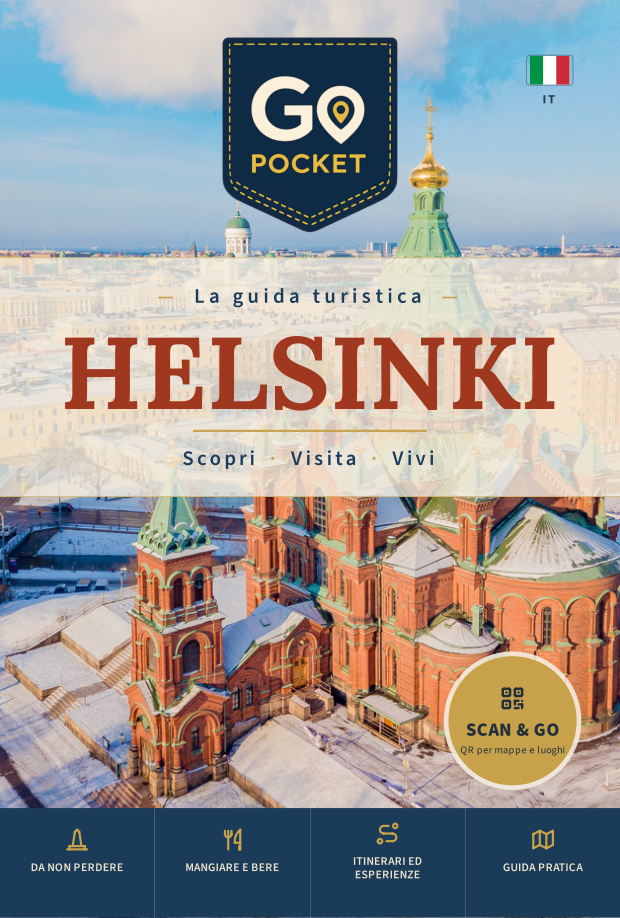
The guide to this city: Helsinki
Digital guide to Helsinki: what to see, where to eat, live maps and tips. Read it like an app, even offline.
Explore · € 4,99 →