Lisbon, the city that destiny has shaped seven times
A city born on water and commerce
Even before becoming the capital of an empire, Lisbon was already an extraordinarily strategic port. Its position at the mouth of the Tagus, just a few kilometers from the Atlantic, made it a natural meeting point between the Mediterranean and Northern Europe. Phoenicians, Greeks, Romans and then Moors had understood its value even before Portugal existed as a nation. This long commercial apprenticeship forged in the Lisbonian a rareness of openness to the world, a genuine curiosity towards the stranger that can still be perceived today in the way the city welcomes those who arrive from afar. It is not superficial cosmopolitanism: it is genetic memory.
The Reconquista and Portuguese identity
In the twelfth century, when Afonso Henriques wrested Lisbon from the Moors, the city became the very symbol of the birth of Portugal as an independent kingdom. That event was not merely military: it was the foundational act of an identity. The Alfama quarter, with its narrow alleys that seem to defy any urban logic, is the most vivid document of that overlap of cultures. Houses climb the hill following Islamic patterns, churches occupy the space of mosques, and in certain corners one has the sensation that time does not flow in a linear way but accumulates, layer upon layer, like the stone itself of the walls.
The age of discoveries: the vertigo of empire
In the fifteenth and sixteenth centuries Lisbon experienced what was probably the most intense moment of its existence. From these shores caravels set out towards the unknown: Brazil, sub-Saharan Africa, the routes to India and the Far East. The city transformed itself into the nerve center of a world commerce before the world had even been completely mapped. Gold, spices, silk, sugar — everything passed through the Tagus. Lisbon became rich in an almost insolent way, and that wealth exploded in art and architecture unique in the world: the Manueline, the decorative style that fuses nautical motifs, cordage carved in stone, armillary spheres and crosses of the Order of Christ in an ornamental gaiety that no other European tradition knows. It is stone that sings the joy of exploration.
The earthquake of 1755: when history starts from zero
Then came the day that changed everything. On the first of November 1755, on All Saints' Day, an earthquake of catastrophic proportions — followed by a tsunami and fires that burned for days — razed much of the city to the ground. The Baixa, the medieval historic center, was almost completely destroyed. It was a wound so deep as to shake the philosophical foundations of Enlightenment Europe: Voltaire wrote of it with horror, calling into question the idea of a providential and benevolent God. But something extraordinary happened in Lisbon: instead of succumbing, the Marquis of Pombal organized the reconstruction with a speed and rationality that still astound historians.
Fado: the voice of a city that remembers
No discourse on the history of Lisbon is complete without fado, the music that is both historical document and collective soul. Born in the working-class quarters of Alfama and Mouraria around the nineteenth century, fado tells of sailors who left and never returned, of impossible loves, of a nostalgia — saudade — that has no equivalent in any other European language. It is not sad music in the common sense of the term: it is aware music, that knows that beauty and loss are the same thing. Those who hear it for the first time often cannot explain why it moves them, even without understanding the words. Perhaps because it speaks of something older than language: it speaks of what it means to be human in a city that has known glory and collapse, and has chosen to sing them both.
The twentieth century and the slow conquest of freedom
Twentieth-century Lisbon is dominated by a long parenthesis of political silence: almost half a century of authoritarian regime under Salazar left deep traces in the social and architectural fabric of the city. Lisbon remained for decades on the margins of European modernization, and what in other contexts would have been a disadvantage proved, paradoxically, a form of preservation. Entire quarters that elsewhere would have been demolished to make way for real estate speculation survived intact, with their peeling azulejos and their decadent palaces that today photographers from all over the world chase like a mirage. Poverty preserved what wealth would have destroyed.
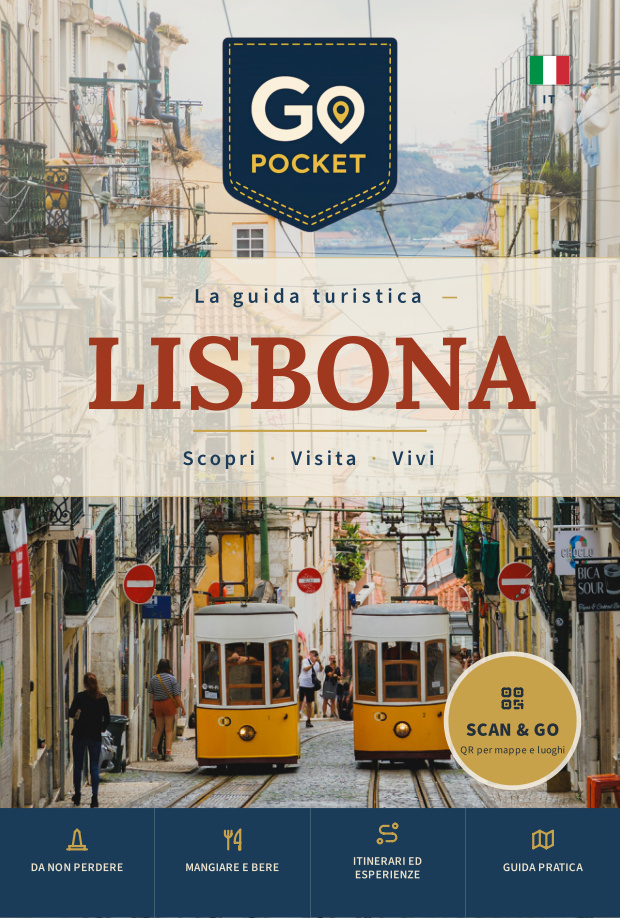
The guide to this city: Lisbon
Digital guide to Lisbon: what to see, where to eat, live maps and tips. Read it like an app, even offline.
Explore · € 4,99 →