Lisbon for those who won't settle for postcards
Fado is not a tourist show
Many visitors encounter fado in a restaurant with tables too close together and napkins folded like fans. It's a legitimate experience, but it's not the one that stays with you. Fado was born in the popular quarters of the city as the language of imperfection, a musical form that the Portuguese invented to give a name to something untranslatable: saudade, that nostalgic yearning for something that perhaps never truly existed. Those who want to truly understand it must seek out the less formal evenings, those where musicians play for themselves before playing for the audience, where sometimes someone from the neighborhood spontaneously gets up to sing. It's not always easy to find these moments — and this difficulty is part of the journey.
The Alfama that is not just Alfama
Lisbon's most photographed neighborhood is also the most misunderstood. Alfama is often reduced to a backdrop for selfies, but it is one of the oldest inhabited quarters of the city, with roots reaching back to the era of Moorish rule — the name itself has Arabic origins, as does much of the nomenclature of this area. Its streets have maintained an ancient and irregular layout that has survived unscathed even the great upheavals in the city's history, and this has preserved them in an organic and chaotic form that tells centuries of cultural overlapping. Walking here in the late afternoon, when tourists head toward the viewpoints for the sunset, means finding yourself in a neighborhood that returns to its own rhythms: chairs outside doors, laundry stretched between one building and another, cats presiding over the steps like guardians of a history that is in no hurry to be told.
The Tagus is not just a backdrop
Lisbon has a visceral relationship with its river, and it's not merely an aesthetic matter. For centuries the Tagus was the point of departure and arrival of the known world: from these waters Portuguese caravels set sail toward routes that would change the geography of collective imagination. Today the river has become a liquid frontier between the city and the opposite shore, and crossing it — perhaps by ferry, as commuters do every morning — is one of those everyday gestures that restores the true scale of Lisbon. Seen from the water, with its hills covered in pastel-colored houses, the city has a sweetest melancholy that no viewpoint can completely convey.
The azulejo as a collective diary
The ceramic tiles that cover facades, churches, train stations and palaces in Lisbon are not merely decoration. The azulejo — a word of disputed origin, which some scholars connect to Arabic and others to Latin roots, a sign of how intertwined the cultural legacies of the Iberian peninsula are — arrived in Portugal centuries ago and over time transformed into something profoundly Portuguese: a visual language through which the city has told stories, celebrated victories, commemorated catastrophes, illustrated the lives of saints and peasants. Some azulejo panels in the city's train stations are true visual epics, capable of telling the history of an entire region in blue and white. Stopping to look at them — truly, at leisure — is one of the most honest ways to understand how the Portuguese see themselves.
The city that is not afraid of decay
One of the things that strikes you about Lisbon is its peaceful coexistence with deterioration. There are buildings that seem to have been waiting for decades for a renovation that never comes, with closed windows and plaster that tells the story of each passing season like a crumpled calendar. In many other European capitals this would be a problem to hide. Here it is almost an aesthetic choice, or at least it has become one: rust, moss, worn stone have such a constant presence that they seem part of the city's identity. There is a form of imperfect beauty that Lisbon carries with it without apologies and without nostalgia — something more conscious and less sentimental than a mere regret for the past.
When slowing down is the only way to see
Lisbon does not reward those in a hurry. It is a city built on multiple hills — a characteristic that the Portuguese willingly cite as a sign of a shared destiny with other capitals with millennial history — and every descent leads to another climb, every turn reveals an unexpected perspective. The right pace to visit it is that of its historic trams: slow, creaking, a bit grumbling. Not for romanticism, but for physical necessity: its slopes require breath, its descents require attention. Those who stop walking efficiently and start walking curiously discover that Lisbon has the generosity of cities that have no need to please anyone. It is there, with all its complexity, and it waits for someone to want to truly understand it.
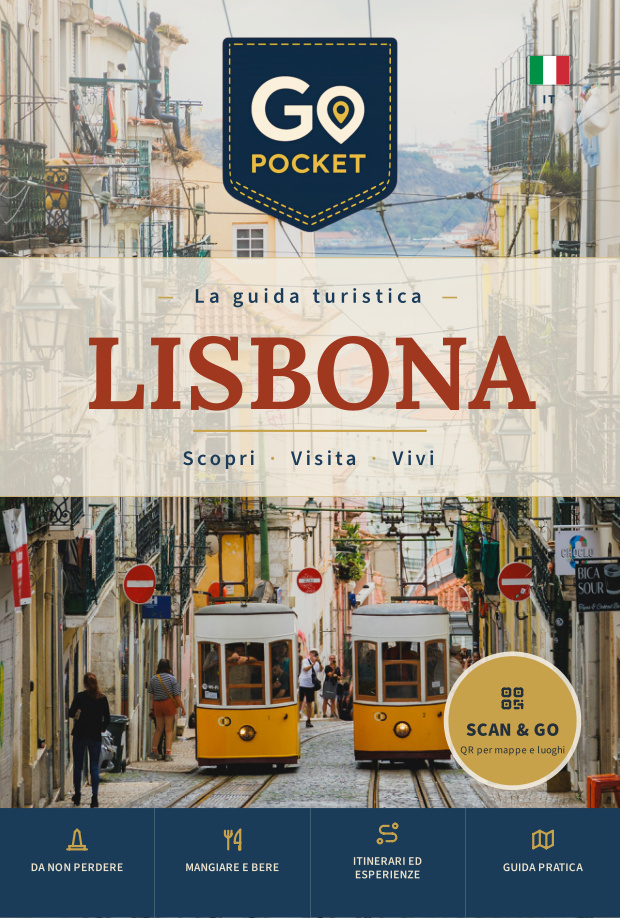
The guide to this city: Lisbon
Digital guide to Lisbon: what to see, where to eat, live maps and tips. Read it like an app, even offline.
Explore · € 4,99 →