Lisbon on foot (and more): how to get around a city that goes up and down
A city built on many hills
Lisboans speak of their hills with a certain pride, and anyone who has walked through Alfama or struggled up towards Graça knows that there are many — or at least it seems that way to your legs. Lisbon was built millennia ago with no regard whatsoever for the comfort of modern tourists, and this is precisely what makes it extraordinary. The historic neighborhoods climb steep slopes, where buildings lean against one another as if to support each other, and limestone staircases become roads in every sense. Understanding this topography before you leave doesn't mean planning every step: it means knowing that the right shoes are not an aesthetic detail, and that a morning spent going up and down on foot is worth as much as any museum.
The yellow tram: icon, not shortcut
Anyone who has seen a photograph of Lisbon has seen the yellow tram creaking through the alleys. The old trams that cross some of the city's most panoramic stretches have become over time one of Europe's most recognizable visual symbols, and this has a price — not in the literal sense, but in the practical one. During peak tourist hours, getting on these trams can require considerable patience, and the romantic experience you imagine at home often has to contend with crowds. It's still worth experiencing, but with tempered expectations: it's an authentic means of transport, not a show put on for visitors. The Lisboans themselves use it, they sit next to you, carry their shopping bags, and this — if you stop to look — is already a story.
The Baixa, the Chiado and the principle of orientation
If there is a ground zero of Lisbon, it is probably the Baixa Pombalina, the flat neighborhood rebuilt after a devastating eighteenth-century earthquake according to a rational and almost Enlightenment grid — a rarity in this city of curves and climbs. Here the streets intersect predictably, the buildings have uniform height, and you can orient yourself almost without a map. It is a neighborhood that tells the story of a city that reinvented itself in the span of a few decades, under the guidance of the Marquis of Pombal, a minister who decided to modernize Portugal through the rubble. Starting from here and then venturing into the affectionate chaos of Alfama or the bohemian atmosphere of Chiado means understanding Lisbon's dual face: order and labyrinth, reason and feeling.
The Tagus as a compass
One of the most useful things you can do in Lisbon is learn to use the river as a point of reference. The Tagus — the Tejo in Portuguese — is so wide in certain places that it seems like a sea, and this makes it visible from almost every height of the city. When you get lost among the alleys of Mouraria or exit a church without knowing which direction you entered, just look for an opening downward: the river is always there, silvery or golden depending on the time of day, serving as a constant reference point. Lisboans have a visceral relationship with water — centuries of Atlantic navigation have left a trace in the soul of the city — and learning to look toward the Tagus is not just a navigation trick, it is tuning in to the mental landscape of those born here.
Neighborhoods as states of mind
One of the most common traps in Lisbon is wanting to see everything in little time by moving frantically from one neighborhood to another. But each bairro has its own rhythm, its own light, its own type of silence. Alfama early in the morning, when tourists haven't arrived yet and cats are still dozing on windowsills, is a completely different experience from Alfama in the afternoon. LX Factory — the reconverted industrial space that overlooks the Tagus — has a weekend energy that doesn't repeat itself on weekdays. Belém, with its monuments to the period of great explorations, is visited with the awareness that here a maritime epic is celebrated that changed the history of the world, for better and for worse. Moving around Lisbon also means deciding how much time you want to spend in a place, resisting the urge to move on.
Slow pace as a philosophy of travel
There is a Portuguese word that Lisboans pronounce with a certain naturalness and that tourists tend to romanticize perhaps excessively: saudade. But beyond poetic interpretations, what you really perceive in Lisbon is a different rhythm, an availability to slow time that manifests itself in concrete things: the bars where you sit for a long time without anyone rushing you, conversations that start by chance between strangers, evenings that begin late and end without hurry. Understanding how to move around Lisbon, ultimately, is not just about public transport or topography: it's about the inner speed at which you decide to traverse it. Those who slow down usually find more than they were looking for.
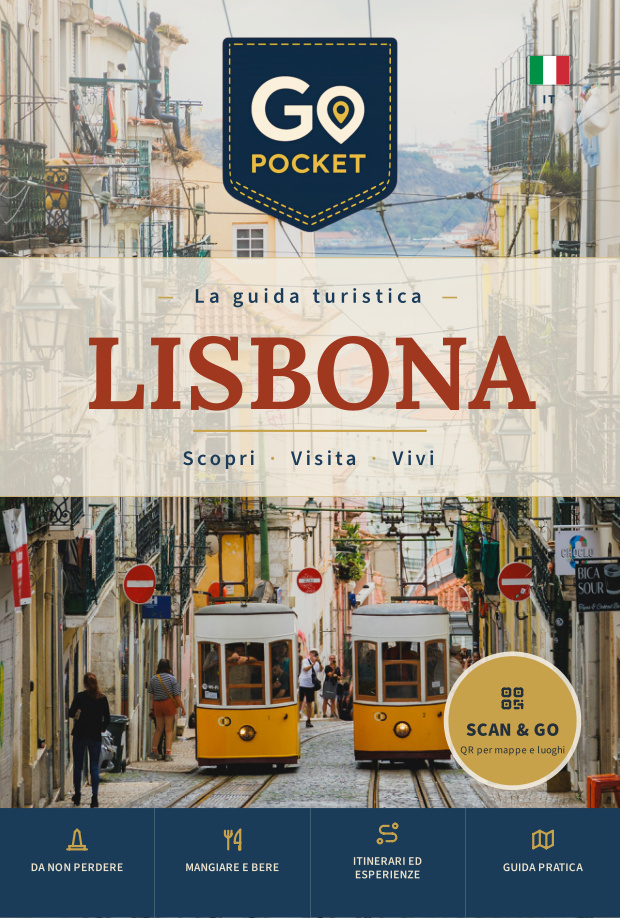
The guide to this city: Lisbon
Digital guide to Lisbon: what to see, where to eat, live maps and tips. Read it like an app, even offline.
Explore · € 4,99 →