Speaking like a Lisboetan: the words that open doors (and hearts) to Lisbon
Saudade: the word that explains everything
Anyone who has read something about Lisbon before leaving already knows this word. But knowing it and hearing it used in context are two completely different experiences. Saudade is not simply nostalgia: it is a form of melancholic desire for something that has been lost, or perhaps never truly had. Portuguese people use it with disarming naturalness, in everyday conversations, in fado songs, in newspaper headlines. When an elderly Lisboetan tells you that they have saudade for a neighborhood as it was thirty years ago, they are using a word that has no exact equivalent in Italian — and hidden in that linguistic gap is a piece of the soul of this city.
Fixe and bacano: the vocabulary of approval
If you want to impress a Lisboetan, learn to say fixe (pronounced more or less 'feesh'). It means 'cool', 'nice', 'excellent' — it's the catch-all adjective of colloquial approval. Whether it's a particularly successful plate of bacalhau or a playlist in a bar in the Intendente, fixe always works. Equally useful is bacano, which in European Portuguese describes something or someone genuinely reliable, trustworthy, approachable. If someone tells you that you are bacanos, you've passed an unwritten social test. Use these words with restraint and with a smile, and you'll see the faces of locals open like windows in the morning.
Bairro and miradouro: the coordinates of the city
Lisbon is thought of in terms of neighborhoods — bairros — and viewpoints — miradouros. These two words are not just tourist vocabulary: they structure the way Lisboetans themselves describe their city. When a local asks you 'which bairro are you from?', they're not asking for your postcode: they're trying to understand what kind of Lisbon you live in, what rhythm, what character. Each neighborhood has a distinct personality that Lisboetans defend with affection and a touch of good-natured local pride. Knowing how to name the neighborhood you're in — and pronouncing it with a certain confidence — will make you seem much less like a tourist than you are.
Desenrascanço: the art of getting by
This is probably the hardest word to pronounce and the most fascinating to understand. Desenrascanço is the distinctly Portuguese ability to find an improvised solution in complicated situations, to 'get out of a jam' with creativity and cool-headedness. It's not cheating: it's ingenuity. The Portuguese speak of it as a national quality, with a certain proud self-irony. If you see someone fix something with makeshift means in a surprisingly effective way, or if a bartender finds a way to serve you exactly what you wanted even though it wasn't on the menu, you are witnessing desenrascanço in action. Naming it in front of a local almost always triggers a laugh of recognition.
Com licença and obrigado/a: the formulas that really matter
Lisboetans are reserved, not rude — but the difference is made by the right words. Com licença ('excuse me') is used much more often than in Italy: to pass through people, to get the waiter's attention, to enter a crowded space. Using it immediately distinguishes you from those who elbow their way through without looking. And then there's the great classic: obrigado if you're a man, obrigada if you're a woman. Portuguese changes the ending based on the gender of the speaker, not the receiver of the thanks — a detail that locals notice and appreciate when it's respected.
Fado and saudade: when words become music
You can't talk about the language of Lisbon without talking about fado, which is itself an emotional vocabulary. Fado is not just a musical genre: it is the way the city has historically put into words what it couldn't say otherwise. Terms like fadista (someone who sings or lives fado), guitarra portuguesa (the stringed instrument that accompanies the voices) and casa de fado (the place where you listen to it) are part of the everyday jargon of many Lisboetans, even those who don't particularly follow the tradition. Understanding that fado is not a spectacle for tourists but a deeply rooted cultural expression — and using the right words to talk about it — opens conversations that would otherwise remain closed.
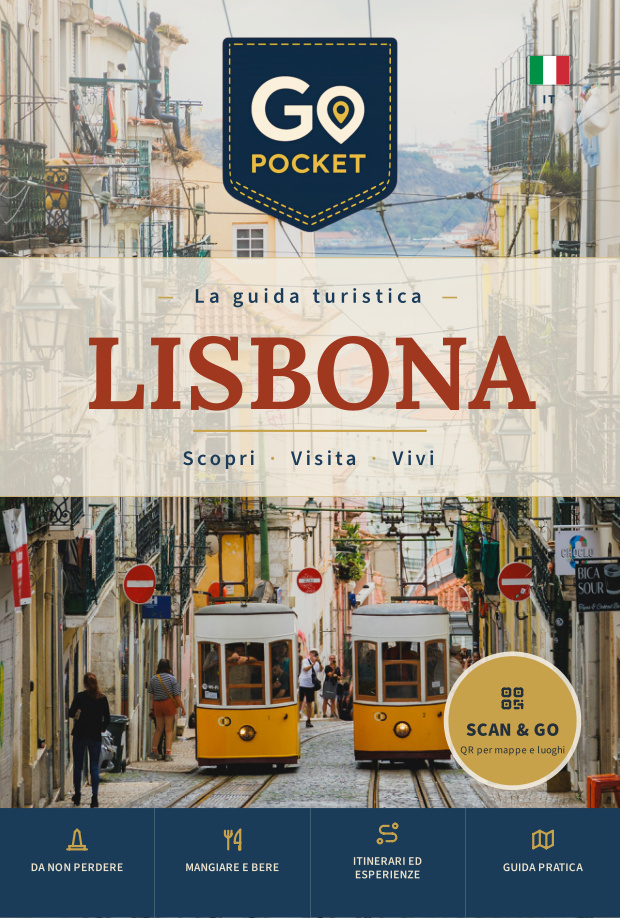
The guide to this city: Lisbon
Digital guide to Lisbon: what to see, where to eat, live maps and tips. Read it like an app, even offline.
Explore · € 4,99 →