Lisbon always surprises: six unusual facts you don't expect
The city that reinvented itself after disaster
In 1755 a very violent earthquake, followed by a tsunami and devastating fires, razed much of Lisbon to the ground in a very short time. The catastrophe struck on a holiday, when many people were gathered in places of worship. The unusual fact, and in some ways paradoxical, is that this immense tragedy became the opportunity to build one of Europe's first planned cities in the modern era. Sebastião de Melo, the powerful Minister of State who led the reconstruction and who would go down in history with the title of Marquis of Pombal, imposed a rational and earthquake-resistant urban project so innovative that it is said engineers resorted to ingenious methods to test the durability of buildings before even inhabiting them. The Baixa pombalina that we tread today, with its perpendicular streets and symmetrical buildings, is actually a eighteenth-century city disguised as an ancient neighborhood.
The seven hills? It depends on who counts
Lisbon is universally described as the city of seven hills, and this brings it together with Rome in a kind of topographic brotherhood that Lisboans cite with pride. The problem is that there is no shared and definitive list of what exactly these seven hills are. Depending on the historical source, the tradition of the neighborhood or the period considered, the list changes. Some hills are split in two, others are grouped together, still others are ignored altogether. The truth is that Lisbon has many more, and the number seven has probably survived for symbolic and narrative reasons rather than geographical ones. After all, seven is the perfect number, that of wonders, of the days of the week, of the deadly sins: too beautiful to give up on.
Fado was not always melancholic
Today fado is perceived as the musical expression of Portuguese saudade, that bittersweet nostalgia that has no translation in any other language. But the origins of this music are far less poetic than one might think: fado was born in the poorest port quarters of Lisbon, frequented by sailors, prostitutes and adventurers returning from the colonies. It was street music, rough, improvised, anything but elegiac. Its transformation into a national symbol and, in more recent times, into a cultural heritage recognized by UNESCO happened slowly, through decades of social and political change. The Salazarist regime, for example, domesticated some of its forms to make it an instrument of consensus and national identity, which also made fado a field of underground cultural battle between conformism and resistance.
A Brazilian emperor hidden among the alleys
Lisbon has a complicated and intense relationship with Brazil, which was a Portuguese colony for over three centuries. But few know that when Napoleon invaded Portugal in the early nineteenth century, the entire Portuguese royal family embarked and transferred the court to Rio de Janeiro, effectively overturning the colonial logic: for several years it was Brazil that hosted the motherland, not the other way around. This episode left profound traces in both cultures. Even today, walking through Lisbon, one encounters architectural and symbolic testimonies to this transatlantic exchange that resembles no other chapter of European colonial history.
The azulejos that tell lies
The hand-painted ceramic tiles that cover facades, churches and stations in Lisbon have become the visual symbol of the city in the world. What few know is that the name azulejo does not derive from azul, the Portuguese word for blue, as it would seem obvious. The most credited etymology traces it back to Arabic, with a meaning related to polished or worked stone, rather than color. And indeed the first tiles used by the Moors in the Iberian peninsula were monochromatic and geometric, far removed from the narrative blue and white scenes that we admire so much today. The dominant blue color arrived much later, through the influence of Chinese porcelain imported by Portuguese trade with the East. Every tiled facade in Lisbon is thus the result of a meeting between distant cultures: Arabia, China, Europe. A globalization ante litteram fixed in fired clay.
Pessoa everywhere, but almost invisible in life
Fernando Pessoa is today the most famous poet of Portugal, the intellectual symbol of Lisbon, whose face looms large on t-shirts, cups and tourist posters in every corner of the city. In life, however, Pessoa was almost unknown to the general public. He worked as a commercial translator and published very little under his own name. The most extraordinary part of his legacy, composed of thousands of texts written with fictitious identities called heteronyms, each with its own biography, style and worldview, was discovered and valued only after his death, when the manuscripts left among his personal effects began to be cataloged and published. Lisbon, in a sense, did not know it had among its alleys one of the most original writers of the twentieth-century Europe. The city celebrated him only when he was no longer there to see it.
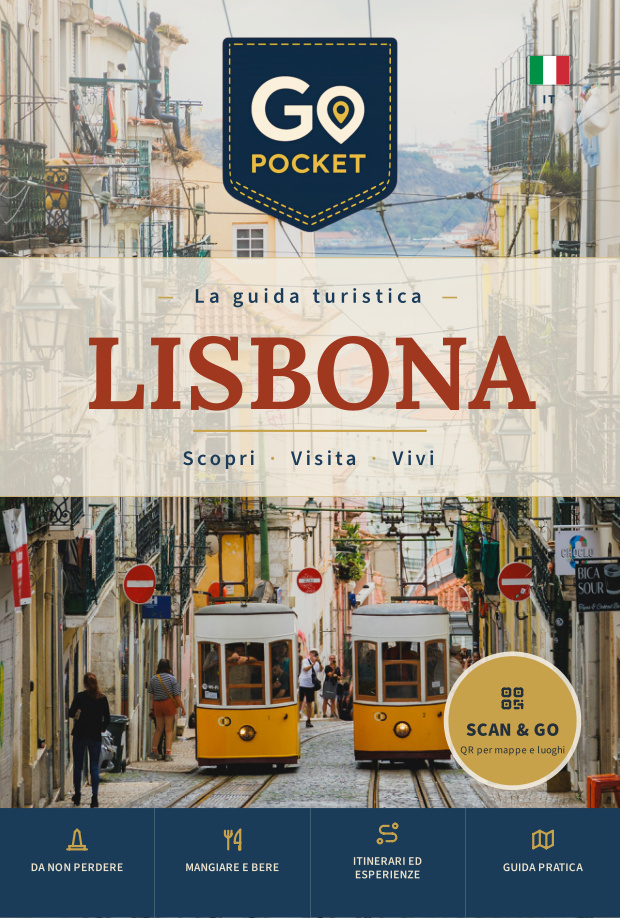
The guide to this city: Lisbon
Digital guide to Lisbon: what to see, where to eat, live maps and tips. Read it like an app, even offline.
Explore · € 4,99 →