Discovering Hamburg's Iconic Landmarks
The Majesty of Hamburg's Rathaus
Hamburg's Rathaus, the city hall, occupies a central place in the city's geography and imagination. It's far more than just the seat of local government: it's a declaration of civic identity. After the devastating 19th-century fire, Hamburg needed to rebuild not just buildings, but trust, institutions, and representation. The city hall emerged from this context, ambitious in demonstrating the continuity of Hamburg's status as a free mercantile power. Its ornate facade, towering spire, and commanding presence communicate a precise political message. Hamburg wanted to be modern, yet conscious of its Hanseatic heritage. Decorative details, statues, and symbolic elements all reference the city's history, commerce, self-governance, and relationship with water. Nothing appears accidental: the palace conveys order, prosperity, and memory. Entering its courtyard or pausing in the plaza before it means observing one of the places where Hamburg stages its vision of itself. Here, power isn't hidden but displayed with restraint. The Rathaus also serves as an excellent starting point for understanding the historic center, as around it converge shopping districts, offices, canals, and remnants of older urban fabric.
Elbphilharmonie: The Modern Musical Heart
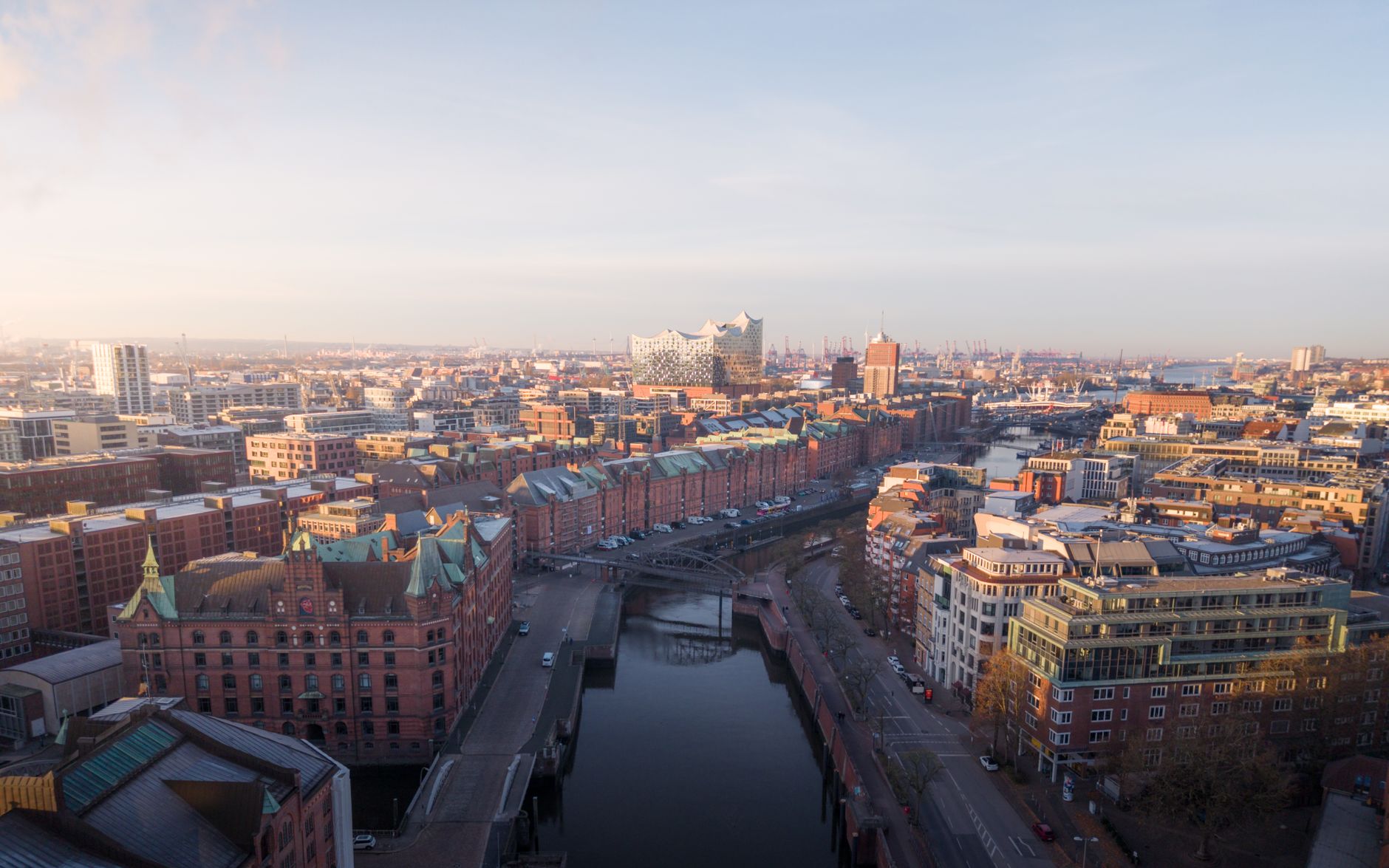
The Elbphilharmonie has quickly become one of Hamburg's most recognizable monuments. Rising above a former port warehouse, it merges two eras: the brick base linked to logistics and commerce, and the glass upper structure associated with culture, music, and the city's new international image. It's a building that doesn't hide the contradictions of urban transformation. Its construction was complex, controversial, and closely followed by residents. Precisely for this reason, its significance extends beyond architecture. The building tells a wager: transforming a port zone into a cultural district without entirely erasing its memory. The undulating roof references water movement, yet remains concrete, tied to the Elbe's landscape. The public-access observation deck has made it familiar even to those who don't attend concerts. From there, you read the port, Speicherstadt, ships, and the compact city behind. The Elbphilharmonie works because it's more than a concert venue: it's become an observation point on Hamburg's transformation.
St. Michael's Church: A Spiritual Symbol
St. Michael's Church, often simply called the 'Michel,' holds a cherished place among Hamburg residents. Its history is marked by destruction and reconstruction—a recurring theme in the city. Fires, war damage, and subsequent interventions never erased its role; rather, each reconstruction strengthened the bond between church and urban community. Its value isn't merely religious. St. Michael's is a civic monument, an orientation point, and a constant presence in the skyline. The steeple, visible from many parts of the city and from the river, once served a practical function for those arriving by water. In a port city, recognizing a tower meant finding your way, not simply admiring a building. Inside, the atmosphere differs from the vitality of surrounding streets. The church invites a pause, even for those not seeking a spiritual experience in the strict sense. It's one of those places where Hamburg's history is felt in layers: Lutheran faith, maritime memory, civic loss, sacred music, and shared identity.
Speicherstadt: The City of Warehouses
Speicherstadt embodies mercantile Hamburg in brick. Its warehouses, overlooking canals and bridges, chronicle an era when goods from distant lands were stored, inspected, and resold. Tea, coffee, spices, carpets, and other products moved through these buildings before entering European markets. Today the area is UNESCO World Heritage together with Kontorhausviertel, yet retains an operational character in collective memory. Its architecture is instantly recognizable: red brick, gabled roofs, regular windows, footbridges, winches, and openings toward the water. Everything followed functional logic. The canals weren't scenery but infrastructure; the warehouses weren't picturesque but working tools. This adherence to function makes the district visually powerful. Speicherstadt's transformation exemplifies interesting urban reuse in Hamburg. Many spaces have changed purpose, hosting museums, offices, cultural activities, and visitor routes. Yet walking the canals in low light, the impression isn't of a domesticated neighborhood: you still perceive the discipline of commerce.
Hamburg Port: Gateway to the World
The port is Hamburg's great distributed monument. It has no single facade and isn't visited like a church or palace, yet it's shaped every aspect of the city: economy, language, imagination, cuisine, neighborhoods, even how residents view the world. The phrase 'gateway to the world' isn't empty rhetoric—it summarizes centuries of exchange and departure. Over time the port has shifted, expanded, and modernized. Historic areas no longer sufficed for contemporary navigation and logistics demands. Containers, terminals, and massive ships changed the landscape's scale. This evolution may seem distant from the historic center, but it actually explains Hamburg's nature well: a city preserving memory while maintaining economic function. Water excursions help understand this dual character. From the river, cranes, basins, and warehouses aren't simple industrial backdrops: they become part of urban narrative. You pass living infrastructure, not romantic ruins. This is why the port remains one of Hamburg's most honest places to observe the city, even when skies are gray and wind cuts sharp.
Hamburg's Canals: A Historic Network of Connections
Hamburg is traversed by a water system belonging not just to the port. Canals, basins, bridges, and river branches have organized the movement of goods and people for centuries. In many city areas, water isn't a boundary but a road. This aspect is fundamental to understanding the urban layout: Hamburg grew by seeking connections, not separations. Internal navigation connected warehouses, markets, production areas, and residential neighborhoods. Before logistics became truck and container-dominated, water was a practical daily resource. Some canals today hold primarily scenic value, yet their form reveals past work. Low bridges, quays, and building alignments recall specific functions. From a traveler's perspective, canals offer different rhythm than major thoroughfares. They let you see building backs, less-official facades, oblique perspectives. Walking along the water or crossing bridges means entering a slower Hamburg, where monuments aren't always isolated buildings but rather the sum of relationships between architecture, light, and movement.
St. Pauli and the Reeperbahn: Culture and Counterculture
St. Pauli is one of Hamburg's most-discussed neighborhoods, yet also among the most misunderstood. The Reeperbahn, its most famous street, connects to nightlife, venues, music, and a long tradition of popular entertainment. This reputation, however, springs from complex social history: sailors, dock workers, artists, immigrants, and alternative communities all built its identity. The neighborhood has evolved while remaining in tension between commerce and counterculture. Alongside venues and neon signs, St. Pauli maintains strong political consciousness and activist urban tradition. It's not merely an entertainment district but a place where the city debates public space, gentrification, rights, and coexistence. This too makes it a living monument rather than mere nighttime scenery. To visit it thoughtfully, look beyond the surface. By day, details emerge invisible at night: murals, theaters, small businesses, proximity to the port. At night, you understand how Hamburg always needed free, loud, imperfect zones. St. Pauli tells the city from below, with all its contradictions.
Modern Architecture's Influence on Historic Monuments
Hamburg doesn't treat the modern as foreign. In many areas, contemporary architecture dialogues with historic buildings, port infrastructure, and reclaimed spaces. The clearest example is HafenCity, where new residential volumes, offices, and public spaces adjoin Speicherstadt and the Elbphilharmonie. The result isn't always uniform, but shows a city accustomed to negotiating change. Modern integration projects succeed when they acknowledge context strength. Brick, water, bridges, and historic alignments become design references, not mere decoration. Hamburg learned that the most convincing modernity doesn't erase previous layers but makes them legible. Even the boldest interventions gain meaning when they illuminate what existed before. Respect for tradition here doesn't mean stasis. The city experienced fires, bombing, and economic shifts making purely museological preservation impossible. So historic monuments coexist with new buildings, often steps apart. The visitor sees an imperfect but coherent city, determined to remain productive, livable, and recognizable.
Lesser-Known Monuments and Their Secrets
Beyond the most-photographed symbols, Hamburg holds monuments and details requiring patient attention. Some sit in secondary squares, others line passing streets, still others tie to work memory and daily life. They don't always possess the Rathaus's monumentality or the Elbphilharmonie's impact, but they deepen understanding of the city's depth. Among less immediate places are church remains, historic commercial buildings, civic statues, commemorative plaques, and small port elements at the margins of well-trodden routes. They're signs speaking of merchants, craftspeople, religious communities, war victims, social movements. Often you need simply to pause before an inscription or facade to sense a larger story. The most interesting discoveries aren't always spectacular. Sometimes they involve a building that survived surrounding change, a repurposed portal, memory preserved in a street name. Hamburg rewards unhurried walking. Its secrets aren't hidden to create mystery: they're simply integrated into urban life, making them more authentic.
Historic Events That Shaped the Monuments
The Great Fire of 1842 ranks among events most profoundly changing Hamburg's face. It destroyed large central areas and forced reconstruction that altered streets, buildings, and urban functions. From that rupture emerged new awareness of the modern city: more organized, more attentive to infrastructure, more eager to represent its economic and political role. World War II inflicted even more extensive wounds. Bombing and fire struck neighborhoods, churches, residential areas, and port structures. Many monuments were damaged, rebuilt, or reinterpreted postwar. In some cases reconstruction sought original appearance; in others it allowed new solutions. This variety tells of difficult relationships between memory and necessity. Visiting Hamburg means reading absences, voids, and reconstructions. Not everything appearing historic remained intact, and not everything new lacks memory. The city often chose pragmatic paths: rebuild to live, remember without halting. Monuments carry this history even when they don't immediately declare it.
Monuments' Role in Hamburg Tourism
Hamburg's monuments shape the city's tourist image but differently from other European destinations. Here heritage encompasses not just palaces and museums: it includes port, canals, neighborhoods, infrastructure, and recent architecture. This variety attracts travelers interested in urban history, music, photography, maritime culture, and contemporary transformations. Cultural events, concerts, festivals, and public programming reinforce bonds between monuments and civic life. The Elbphilharmonie isn't only for observation, the port isn't only for crossing, St. Pauli isn't only for storytelling. They're places producing experiences, encounters, memories. Tourism works best when not separating monument from community using it. Tourism's economic impact is evident, but Hamburg maintains certain restraint in self-presentation. It doesn't abandon promotion yet preserves less-scenic character than other cities. This can be advantageous: visitors discover concrete heritage tied to real work and history. Monuments don't merely decorate the visit but explain it.
Discovering Hamburg Through Lesser-Known Stories
Hamburg's finest stories often come from residents: a guide remembering a neighborhood before transformation, a resident pointing out a facade detail, a musician discussing the Reeperbahn beyond stereotypes. These voices don't replace official history but make it closer and more comprehensible. Local historians often emphasize one point: Hamburg is a city of interrupted continuity. It lost much, rebuilt much, transformed nearly everything. For this reason monuments should be viewed as moving documents. A warehouse can become cultural space, a church can mean civic memory, a quay can tell of global commerce and anonymous lives. Visitor experience arises precisely from this interweaving. You might arrive to see City Hall or the Elbphilharmonie and end remembering a bridge, light on canals, a voice heard during a visit, a side street in St. Pauli. Hamburg asks for attention, not adoration. When you listen, its monuments tell far more than their form.
FAQ
What is Hamburg's most famous monument?
The most iconic is the Elbphilharmonie, renowned for its unique architecture and panoramic views.
How many monuments are there in Hamburg?
Hamburg boasts incredible monument variety, from historic palaces to modern structures, with hundreds classifiable as such.
Where is St. Michael's Church located in Hamburg?
St. Michael's Church, known as the Michel, sits in the heart of Hamburg's old town.
Why is the Elbphilharmonie so famous?
The Elbphilharmonie is celebrated for its innovative design and exceptional concert hall acoustics.
What's the story behind Hamburg's Rathaus?
The Rathaus was rebuilt after a devastating 1842 fire and symbolizes Hamburg's autonomy and resilience.
The guide to this city: Amburgo
Digital guide to Amburgo: what to see, where to eat, live maps and tips. Read it like an app, even offline.
Explore · € 4,99 →